
Witness Lee wrote: “We believe that the entire Bible, every word in the Scripture, is God-breathed. Nevertheless, not every word in the Bible is the word of God” (Life-Study of James, msg. 14 ↗).
He applied that second sentence not only to the serpent’s words in Genesis 3 but to passages that teach God’s people how to live. Psalm 1 “was written wrongly with a wrong concept, a human concept” (Life-Study of Psalms, msg. 1 ↗). In the verses of Psalm 19 that praise God’s law, David “was ‘Cain.’” Job is “a record of human views,” with “no prayer or praise offered to God” (Life-Study of Job, msg. 36 ↗). James’s teaching “may be godly, but it is not God’s word” (Life-Study of James, msg. 14 ↗). Proverbs is “not the word directly from God” (Life-Study of Proverbs, msg. 6 ↗). And following Jesus “in meekness and in patience” is “absolutely off” (High Peak, ch. 2 ↗).
His test for which was which came from his own system: what fits “God’s economy” was “uttered by God”; what “uplifts the law” is “the human concept of the holy writers” (Life-Study of Psalms, msg. 1 ↗). Peter said the opposite: “prophecy never came by the will of man, but holy men of God spoke as they were moved by the Holy Spirit” (2 Peter 1:21).
This post began as part of the post on Witness Lee and the Gnostics. Around AD 180, Irenaeus described how the Gnostics answered when Scripture stood against them (below). Lee taught nothing like their cosmology. The parallel is in how Scripture gets handled: it stays in the Bible, but only the parts that fit the system count as God speaking. Each passage below gets God’s word first, then Lee’s reading of it, then what the rest of Scripture says. Every quote links to its source.
“When, however, they are confuted from the Scriptures, they turn round and accuse these same Scriptures, as if they were not correct, nor of authority, and [assert] that they are ambiguous, and that the truth cannot be extracted from them by those who are ignorant of tradition.”
Following Jesus
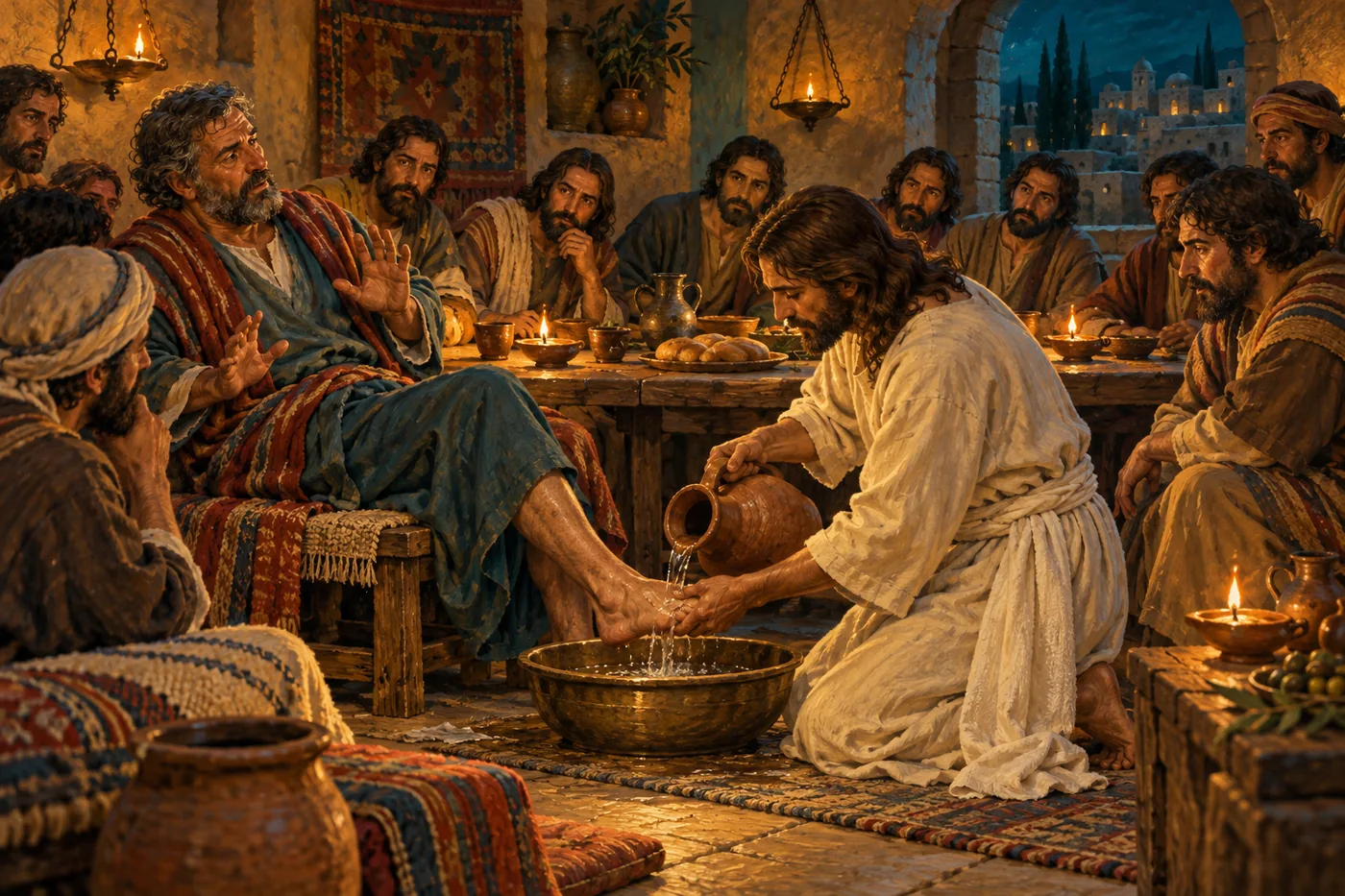
29Take My yoke upon you and learn from Me, for I am gentle and lowly in heart, and you will find rest for your souls.
Lee was taught as a young man that “Jesus was meek and patient, so we have to follow Jesus in meekness and in patience.” His verdict: “Apparently, this teaching is right, but intrinsically, it is absolutely off.” Following Jesus, he said, is to live “not by the human life but by the divine life,” with God’s “divine attributes becoming the human virtues.” And: “The Christian life is not a matter of outwardly loving people or of being meek or patient in our human ethics.” (High Peak, ch. 2 ↗)
The apostles never set the inward life against the outward example. Jesus: “I have given you an example, that you should do as I have done to you” (John 13:15). Peter: Christ left “us an example, that you should follow His steps,” and then described the steps: He did not sin, did not revile, did not threaten (1 Peter 2:21–23). Paul holds both together: “work out your own salvation with fear and trembling; for it is God who works in you” (Philippians 2:12–13). Gentleness is “the fruit of the Spirit” (Galatians 5:22–23), and a few verses later it is a command: “you who are spiritual restore such a one in a spirit of gentleness” (Galatians 6:1). What the Spirit produces, believers are told to do.
Psalm 1

1Blessed is the man who walks not in the counsel of the ungodly, nor stands in the path of sinners, nor sits in the seat of the scornful;
2But his delight is in the law of the LORD, and in His law he meditates day and night.
3He shall be like a tree planted by the rivers of water, that brings forth its fruit in its season, whose leaf also shall not wither; and whatever he does shall prosper.
4The ungodly are not so, but are like the chaff which the wind drives away.
5Therefore the ungodly shall not stand in the judgment, nor sinners in the congregation of the righteous.
6For the LORD knows the way of the righteous, but the way of the ungodly shall perish.
Lee taught that the psalmists “uttered two kinds of concepts — the human concept and the divine concept,” and he put Psalm 1 in the first: “Psalm 1 is good, but it was written with a wrong concept… we should not highly appraise Psalm 1. It was written wrongly with a wrong concept, a human concept.” The writers, he said, “were wrong in their understanding according to their human concept,” and “while they were speaking wrongly, God came to speak through them.” (Life-Study of Psalms, msg. 1 ↗)
Lee’s own example points the other way. He cites Psalm 73, where the psalmist sees the wicked prosper, but that psalm ends in the sanctuary by confirming Psalm 1: “Then I understood their end… You cast them down to destruction” (73:17–18). Paul says “all Scripture is given by inspiration of God” (2 Timothy 3:16), and Jesus quoted a psalm and said, “the Scripture cannot be broken” (John 10:35). And the New Testament repeats Psalm 1 almost line by line.
| Psalm 1 | New Testament |
|---|---|
| v. 1: not walking in the counsel of the ungodly | “Evil company corrupts good habits”1 Corinthians 15:33 |
| v. 2: delighting in the law | “He who looks into the perfect law of liberty and continues in it… will be blessed in what he does”James 1:25 |
| v. 3: the fruitful tree | “He who abides in Me, and I in him, bears much fruit”John 15:5 |
| v. 3: whatever he does shall prosper | “Godliness is profitable for all things, having promise of the life that now is and of that which is to come”1 Timothy 4:8 |
| v. 4: the chaff | “He will burn up the chaff with unquenchable fire”Matthew 3:12 |
| v. 5: the judgment | “We must all appear before the judgment seat of Christ”2 Corinthians 5:10 |
| v. 6: the two ways | “Broad is the way that leads to destruction… narrow is the gate and difficult is the way which leads to life”Matthew 7:13–14 |
Jeremiah uses Psalm 1’s picture for faith: “Blessed is the man who trusts in the LORD… he shall be like a tree planted by the waters” (Jeremiah 17:7–8). James 1:25 is practically Psalm 1:2–3 again: the one who “looks into the perfect law of liberty and continues in it… will be blessed in what he does.” It is the same verse Lee says readers take “according to the natural understanding” (Life-Study of James, msg. 13 ↗).
Three more psalms

7The law of the LORD is perfect, converting the soul; the testimony of the LORD is sure, making wise the simple;
11Moreover by them Your servant is warned, and in keeping them there is great reward.
1LORD, who may abide in Your tabernacle? Who may dwell in Your holy hill?
2He who walks uprightly, and works righteousness, and speaks the truth in his heart;
6This poor man cried out, and the LORD heard him, and saved him out of all his troubles.
Psalm 19 praises God’s word: “The law of the LORD is perfect, converting the soul… in keeping them there is great reward” (19:7, 11). Lee gives David credit for the first half of the psalm, where the heavens declare God’s glory, but not for this: “In verses 1-6, he was ‘Abel’; in verses 7-11, he was ‘Cain.’” The reward for keeping God’s commandments, he says, “is not according to the divine concept of the New Testament economy of God.” (Life-Study of Psalms, msg. 9 ↗) Paul says, “the law is holy, and the commandment holy and just and good” (Romans 7:12). Jesus told the rich young ruler, “if you want to enter into life, keep the commandments” (Matthew 19:17).
Psalm 15 asks, “LORD, who may abide in Your tabernacle?” and answers, “He who walks uprightly, and works righteousness, and speaks the truth in his heart.” Lee: “This may seem like an excellent psalm, but actually it is a psalm in the line of the tree of the knowledge of good and evil.” (Life-Study of Psalms, msg. 7 ↗) Jesus said, “Blessed are the pure in heart, for they shall see God” (Matthew 5:8), and “If anyone loves Me, he will keep My word; and My Father will love him, and We will come to him and make Our home with him” (John 14:23). John: “He who practices righteousness is righteous, just as He is righteous” (1 John 3:7).
Psalm 34 says, “This poor man cried out, and the LORD heard him, and saved him out of all his troubles” (34:6). Lee: “In this psalm he gave all the credit to God, but actually he delivered himself by disguising himself. To disguise oneself is a kind of falsehood.” (Life-Study of Psalms, msg. 16 ↗) Peter quotes the same psalm to believers as instruction (1 Peter 3:10–12), and John says Christ fulfilled it: “Not one of His bones shall be broken” (John 19:36).
Job

8Then the LORD said to Satan, “Have you considered My servant Job, that there is none like him on the earth, a blameless and upright man, one who fears God and shuns evil?”
Lee grants that “ethically speaking, Job was very good,” and that “God even boasted to Satan regarding how good Job was.” But he ranks fearing God below his own goal: “Even with the positive matter of fearing God, there is not anything that is actually positive… To fear God and turn away from evil is not adequate, and actually this is not positive. The most positive thing is to express God.” Of the whole book he says: “The book of Job… is a record of human views based on human concepts… In this book there is no prayer or praise offered to God… there is no hint that Job, his three friends, and Elihu had any kind of thirst for God.” (Life-Study of Job, msg. 2 ↗ and msg. 36 ↗)
Open the book. Job “fell to the ground and worshiped” and said, “Blessed be the name of the LORD” (1:20–21). He said, “I know that my Redeemer lives… in my flesh I shall see God… How my heart yearns within me!” (19:25–27), and “Oh, that I knew where I might find Him” (23:3). “The LORD restored Job’s losses when he prayed for his friends” (42:10). The same book says, “The fear of the Lord, that is wisdom, and to depart from evil is understanding” (28:28), the pair Lee called “not adequate.” At the end God tells Job’s friends, “you have not spoken of Me what is right, as My servant Job has” (42:7). And the apostles commended the fear of God itself: “in every nation whoever fears Him and works righteousness is accepted by Him” (Acts 10:35). And God himself names Job with Noah and Daniel for “their righteousness” (Ezekiel 14:14).
James

22But be doers of the word, and not hearers only, deceiving yourselves.
23For if anyone is a hearer of the word and not a doer, he is like a man observing his natural face in a mirror;
24for he observes himself, goes away, and immediately forgets what kind of man he was.
25But he who looks into the perfect law of liberty and continues in it, and is not a forgetful hearer but a doer of the work, this one will be blessed in what he does.
Readers may say, Lee wrote, “James is right in saying that we should be doers of the law.” But “if we read the Bible this way, we read it according to the natural understanding, not according to the enlightenment of the Spirit.” Lee says every word of the Bible is God-breathed, then places James’s letter alongside the serpent’s words in Genesis 3 and Peter’s rebuke in Matthew 16: recorded by God, but not God’s word (Life-Study of James, msg. 14 ↗). That is having it both ways: God-breathed in name, but not God’s word in practice. James’s teaching on “visiting widows and orphans, keeping oneself unspotted from the world… saying, ‘If the Lord wills,’” he wrote, “may be godly, but it is not God’s word.” James, he said, “was somewhat off from God’s economy.” (Life-Study of James, msg. 13 ↗, msg. 14 ↗, and msg. 5 ↗)
The serpent and Peter are corrected inside Scripture itself. James’s letter never is. And “be doers of the word” was not James’s own idea. Jesus said it first: “whoever hears these sayings of Mine, and does them, I will liken him to a wise man who built his house on the rock” (Matthew 7:24).
Read more: Witness Lee, James, and Paul →Ecclesiastes
11The words of the wise are like goads, and the words of scholars are like well-driven nails, given by one Shepherd.
What Solomon concluded from his experiments, Lee wrote, “should not be considered the divine revelation from God, though they are included in the Scriptures.” He allowed that the book’s concluding words “may be considered as proverbs, words of wisdom.” (Life-Study of Ecclesiastes, msg. 2 ↗)
Ecclesiastes says its own words are “given by one Shepherd” (12:11), and Paul says “all Scripture is given by inspiration of God” (2 Timothy 3:16).
Proverbs
11My son, do not despise the chastening of the LORD, nor detest His correction;
12For whom the LORD loves He corrects, just as a father the son in whom he delights.
Lee wrote that Proverbs “is recorded in the Word of God, but it is not the word directly from God. Rather, it is the word of many wise men, especially Solomon.” He grants that its words “are the word of God because they are in the Bible,” but says that “when we contact it by our natural man, it is not the word of God to us.” In his first message on the book, he says it helps an ethical person “cultivate yourself,” but “it does not help you to be a person who lives in his spirit… for the accomplishment of God’s eternal economy.” (Life-Study of Proverbs, msg. 6 ↗ and msg. 1 ↗)
The New Testament quotes Proverbs as God speaking. James introduces Proverbs 3:34 with “Therefore He says: ‘God resists the proud, but gives grace to the humble’” (James 4:6). Hebrews calls the passage above “the exhortation which speaks to you as to sons” (Hebrews 12:5–6). Paul’s “will render to each one according to his deeds” (Romans 2:6) quotes Psalm 62:12 and Proverbs 24:12. And Proverbs itself says, “Every word of God is pure” (30:5).
How Lee decided what is God’s word
In each case Lee names his standard, and it comes from his own system: God’s economy, the God-man, expressing God. The clearest example is in the Psalms. Psalms 1 and 2 have the same author, but Lee says, “The first psalm was uttered according to the human concept spoken by David directly. The second psalm was also David’s speaking, but it was actually uttered by God.” Then “in Psalms 3 through 7, there is David’s tone again, but in Psalm 8 God’s tone came.” His reason: the “divine concept” “is concerning His eternal economy in Christ,” while “the human concept of the holy writers uplifts the law as their central emphasis.” (Life-Study of Psalms, msg. 1 ↗)
| Scripture | Lee |
|---|---|
| Called God’s word | |
| Psalm 2: “Kiss the Son… Blessed are all those who put their trust in Him” | “actually uttered by God”; “it is a matter of taking refuge in Christ”Life-Study of Psalms, msg. 1 |
| Psalm 8: “O LORD, our Lord, how excellent is Your name in all the earth” | “in Psalm 8 God’s tone came”Life-Study of Psalms, msg. 1 |
| Called human | |
| Psalm 1: “His delight is in the law of the LORD” | “written wrongly with a wrong concept, a human concept”; the human concept “uplifts the law”Life-Study of Psalms, msg. 1 |
| Psalms 3–7 | “David’s tone again”Life-Study of Psalms, msg. 1 |
| Psalm 15: “He who walks uprightly, and works righteousness” | “a psalm in the line of the tree of the knowledge of good and evil”Life-Study of Psalms, msg. 7 |
| Psalm 19:7: “The law of the LORD is perfect, converting the soul” | “in verses 7-11, he was ‘Cain’”; the reward for keeping God’s commandments is “not according to the divine concept of the New Testament economy of God”Life-Study of Psalms, msg. 9 |
| James 1:22: “Be doers of the word” | “may be godly, but it is not God’s word”; James “was somewhat off from God’s economy”Life-Study of James, msgs. 5 and 14 |
| Job 1:8: “a blameless and upright man, one who fears God” | “not anything that is actually positive”; “The most positive thing is to express God”Life-Study of Job, msg. 2 |
| Matthew 11:29: “Learn from Me, for I am gentle and lowly in heart” | “apparently… right, but intrinsically… absolutely off”; “you must be a God-man”High Peak, ch. 2 |
| Ecclesiastes: Solomon’s conclusions | “should not be considered the divine revelation from God”; they are “the conclusion of the writer’s research”Life-Study of Ecclesiastes, msg. 2 |
| Proverbs | “not the word directly from God”; it does not help one live “for the accomplishment of God’s eternal economy”Life-Study of Proverbs, msgs. 1 and 6 |
Same author, same book. What decides whether a psalm is God’s word or a “human concept” is whether it fits the system. In the Psalms, what speaks of Christ is “uttered by God” and what exalts the law is human, even when the psalm is praising God’s own law. Elsewhere the same test sets aside doing the word, fearing God, and following Jesus in meekness. The system tests Scripture, instead of Scripture testing the system.
Lee’s Life-studies and “letters”
Lee contrasted reading the Bible “by the way of letters” with reading it “by the way of the Spirit and of life.” “Most Christians today,” he said, “have made the New Testament of the Spirit and of life the Old Testament of letters… Too many Christians have made the New Testament proverbs, precepts, exhortations, and instructions of letters. Our life-studies have made all of the Old Testament as the Word of God books of the Spirit and of life.” (Life-Study of Proverbs, msg. 1 ↗)
He does not say the Life-studies are required, and he is right that the Bible can be read without coming to Christ (John 5:39–40). But Paul’s “the letter kills, but the Spirit gives life” (2 Corinthians 3:6) is about the old covenant, “the ministry of death, written and engraved on stones” (3:7), not about reading the New Testament’s commands plainly. Lee applies “letters” to those very “precepts, exhortations, and instructions” (Life-Study of Proverbs, msg. 1 ↗), including “be doers of the word.” And Jesus said His words already “are spirit, and they are life” (John 6:63).
The Bible can be understood plainly
The apostles wrote to be understood. Paul: “we are not writing any other things to you than what you read or understand” (2 Corinthians 1:13), and “when you read, you may understand my knowledge in the mystery of Christ” (Ephesians 3:4).
The Bereans checked even the apostle Paul: they “searched the Scriptures daily to find out whether these things were so,” and Luke calls them fair-minded (Acts 17:11). Irenaeus gave the reason it is safe to check: “error is plausible… but requires to be disguised; while truth is without disguise, and therefore has been entrusted to children” (Against Heresies, Book III, Chapter 15 ↗).
Peter warned about this. Some things in Paul’s letters are hard to understand, “which untaught and unstable people twist to their own destruction, as they do also the rest of the Scriptures” (2 Peter 3:16).
“For error is plausible, and bears a resemblance to the truth, but requires to be disguised; while truth is without disguise, and therefore has been entrusted to children.”