
Witness Lee condemned denominational Christianity as fallen, divisive, and connected with Babylon. Yet the Recovery he built has the features people normally mean by a denomination: a distinctive theology, a worldwide network of congregations, central publishing institutions, training, internal authority, and a boundary between those inside the Lord’s Recovery and Christians outside it.
The difference is largely a matter of naming. The churches do not use a conventional denominational label. They call each congregation “the church in” its city and present that wording as a biblical recovery rather than an organizational name. But refusing a label does not prevent a movement from functioning as a denomination.
Lee’s judgment on other churches

Lee did not merely criticize particular abuses or acknowledge that Christian denominations have caused division. He portrayed the denominational system itself as Satanic and under God’s judgment. In the same passage, he compared denominational Christianity to Babel and Babylon and presented the Lord’s Recovery as those called out of it.
His language was even more sweeping elsewhere. An official Local Church defense reproduces his declaration that Christianity, Christendom, Catholicism, and all denominations are fallen. The defense supplies the surrounding Revelation passages and argues that Lee was denouncing a corrupt system, not every individual Christian. That distinction matters, but it does not make the words less sweeping. Lee still identifies all denominational Christianity with the system that must fall.
“The denominational organizations have been utilized by Satan to set up his satanic system to destroy God’s economy of the proper church life.”
“Christianity is fallen, Christendom is fallen, Catholicism is fallen, and all the denominations are fallen. Hallelujah!”
A worldwide movement with one ministry and one voice
A denomination is more than a name on a sign. It is a religious body organized around a shared doctrine, identity, and means of deciding what teaching is acceptable. By that ordinary description, the Recovery functions as a denomination. It has a recognizable body of teaching associated with Watchman Nee and Witness Lee, publishing institutions, coordinated training, and congregations encouraged to receive one stream of ministry.
Living Stream Ministry’s own statement says that one publication safeguards “the unique ministry in the Lord’s recovery.” It describes Living Stream Ministry and Taiwan Gospel Book Room as the practical means by which the one publication and the ongoing ministry are carried throughout the churches. Lee said that the Recovery’s sounding “must be one” (Publication Work in the Lord’s Recovery ↗), and urged workers to be restricted to one publication.
Those are not incidental administrative details. They establish who supplies the approved teaching for the churches and who decides whether a different publication has the right “taste,” light, or authority. This is precisely how a distinct religious movement maintains its doctrinal identity.
“The one publication is not only a testimony of our oneness in the Body but also a safeguard for the unique ministry in the Lord’s recovery.”
“Our sounding must be one, so we must be restricted in one publication.”
- A distinctive theologyThe teaching associated with Watchman Nee and Witness Lee
- A worldwide network of congregationsA “church in” each city, across many countries
- Central publishingLiving Stream Ministry and Taiwan Gospel Book Room, and “one publication”
- Coordinated trainingTrainings and conferences that carry one stream of ministry
- Internal authority over teachingWho decides whether a publication has the right “taste”
- A boundary around the movement“The Lord’s recovery,” set against fallen “Christianity”
- A denominational name: declinedEach congregation is called “the church in” its city
Saved individuals, rejected churches
Lee did say that real, saved Christians exist in every denomination, including Roman Catholicism. That should be acknowledged. But it is not the same as recognizing their congregations as legitimate expressions of Christ’s church. The individual may be called a brother or sister while the church they worship in is described as fallen Babylon, a Satanic system, or an organization under God’s judgment.
That is a conditional kind of acceptance. Christians outside the Recovery can be welcomed as potential brothers and sisters, but their churches, teachers, and doctrinal convictions are treated as part of a system from which they should come out. The Recovery is then placed on the other side as the proper church life and God’s recovered way.
Many Christians across denominational lines disagree deeply while still recognizing other congregations as true churches and seeking fellowship where they can. Lee’s framework leaves much less room for that. It acknowledges the salvation of individual believers but denies the legitimacy of the churches in which most believers live out that faith.
The individual believer
- Real, saved Christians in every denominationLife-Study of Genesis, message 34
- May be called a brother or sister
The church they worship in
- “Utilized by Satan to set up his satanic system”Life-Study of Genesis, message 34
- “All the denominations are fallen”The Seven Spirits for the Local Churches
- The remedy: come out of it, into “the Lord’s recovery”
What happened when brothers disagreed with Lee?
The decisive test is not whether Lee could speak charitably about Christians at a distance. It is what happened when Christians challenged his own ministry. In a published message about dissenters in the Recovery, Lee says their aim was to poison the saints so they would give up what he taught. He calls the situation a sickness full of germs and tells members to practice a strict quarantine.
The full passage is available online, not hidden behind a short excerpt. Lee tells readers not to argue with dissenters or even find out what they are saying, because it is impossible to talk with them without contamination by their poison. That posture leaves no meaningful room for brothers who reach a different conclusion about Lee’s teaching but want to remain in Christian fellowship.
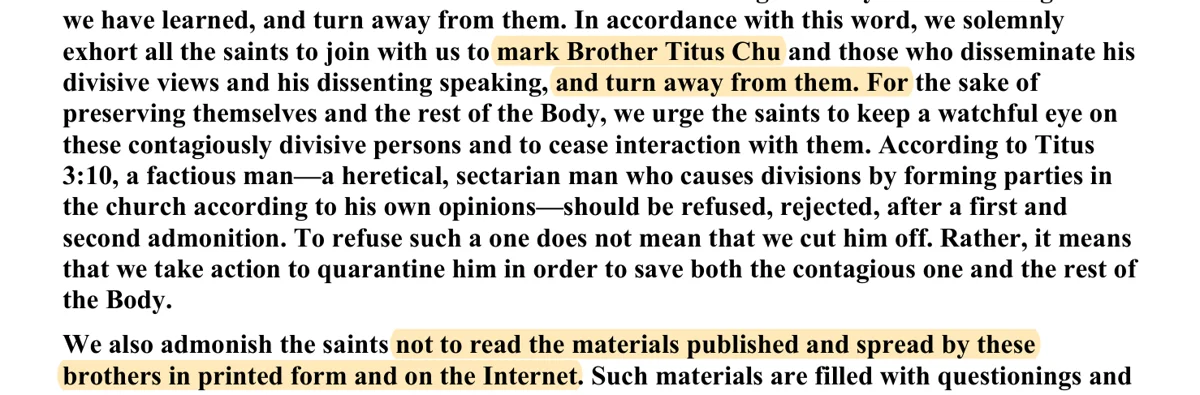
The practice outlived Lee. In 2006, nine years after his death, the blending co-workers issued A Warning to All the Saints and All the Churches in the Lord’s Recovery Concerning Titus Chu ↗, a long-serving co-worker raised up through Lee’s ministry. It asks the saints to “mark Brother Titus Chu and those who disseminate his divisive views and his dissenting speaking, and turn away from them,” and “not to read the materials published and spread by these brothers.” Its first charge is not immorality or a denial of Christ. It is “challenging and rejecting the teaching of Brother Watchman Nee and Brother Witness Lee concerning the uniqueness of the vision of the age, the ministry and the minister of the age.” The co-workers’ defense of the warning cites Lee’s 1990 quarantine as its precedent.
A movement that calls other churches Babylon while treating internal disagreement as poisonous does not escape sectarianism by declining the word denomination. It displays the same boundary-making impulse in a more absolute form.
“Their aim is to poison the saints so that they will give up anything that Witness Lee teaches.”
“To avoid further damage by the present turmoil, we need to practice a strict quarantine over this contagious disease.”
The double standard

Lee condemned other Christian bodies for having a distinctive name, a separate identity, and different doctrine. Yet the Recovery developed its own distinctive identity around Lee’s teaching, its own publication and training system, and its own claims about the proper church life. The system does not become non-denominational simply because it rejects the word denomination.
The deeper problem is not that Christians organize themselves, use ministry resources, or have doctrinal convictions. Every church does those things. The problem is claiming that other Christian bodies are fallen while treating one’s own movement as the unique recovery, then treating those who question that claim as dangerous or divisive.
That is why the contrast matters. Witness Lee did not simply call Christians to greater unity. He built a separate global body around a unique ministry and declared the other bodies fallen. That is not a recovery from denominationalism. It is a double standard.